

Three Rows, No Compromises: How the 2026 Ford Explorer Beats the Chevy Traverse
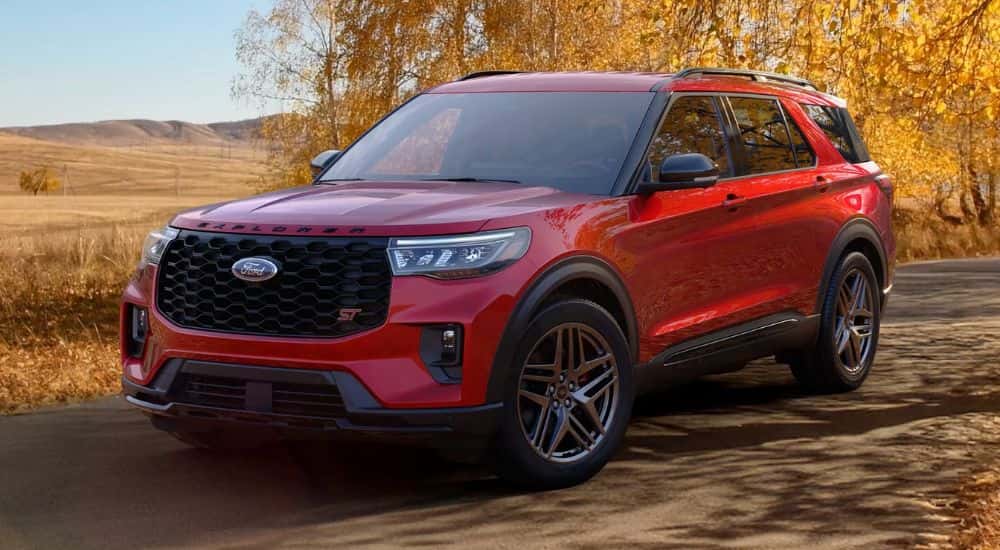 The Explorer has long occupied a unique spot in the SUV market. The three-row model has all the space you’ll need to handle the rigors of family life, but can also provide plenty of power and thrills, with both off-road and performance trims to choose from.
Ford’s midsize maestro offers something for every driver. From the affordable base model with its efficient turbocharged engine to the stylish ST-Line, off-road-ready Tremor, sporty ST, and premium Platinum trim, Ford makes it easy to dial in your preferred combination of performance, comfort and convenience.
The Explorer isn’t the only model in the three-row class. While it’s been the segment’s bestselling SUV for 15 years, buyers can’t be blamed for wanting to explore their options. The Chevy Traverse routinely places just behind the Explorer in the sales charts, though this distinction can be a bit misleading. While the Traverse is the segment’s second-bestselling model, it trailed the Explorer by some 75,000 units in 2025.
What’s with this gulf in sales? How has the Ford Explorer come to dominate the competitive three-row category? We’ll answer all that and more as we pit the 2026 Ford Explorer vs 2026 Chevy Traverse in a battle between the two bestselling three-row models.
The Rear-Wheel Drive Difference
It’s hard to underestimate the importance of sheer performance when choosing between three-row models. While a smaller SUV might be able to get away with a relatively pedestrian powertrain, larger models need plenty of muscle if they expect to transport seven passengers, conquer off-road terrain, and provide the towing capacity that buyers have come to expect from the class.
Unfortunately, that sort of power has become increasingly rare in the three-row segment. While V6 setups once ruled the day, automakers have turned to turbocharged I-4 designs to meet strict efficiency standards. That might be good for the environment, but it can lead to an uninspired experience when you’re trying to get up to speed on the highway or pull a heavy load.
This is where the 2026 Explorer distinguishes itself from its midsize rivals. The SUV’s available 3.0L turbocharged V6 is one of the segment’s last V6 options, and the only one capable of producing more than 300 hp. In fact, with 385 hp and 415 lb-ft of torque, the Explorer outperforms every model except the V8-powered Dodge Durango.
It’s not just pure power that makes the Explorer such an enticing option. Like most models in the segment, the Explorer can be had with all-wheel drive, but the crossover also sets itself apart with a rear-wheel drive layout. This offers some compelling performance benefits when compared to the dominant front-wheel drive approach.
By sending power to the rear wheels, the Explorer offers the sort of acceleration that’s long made this the go-to design in most sports cars and other performance-focused models. This also frees up the front wheels to focus on steering, which can make a big difference in control and comfort.
The Chevy Traverse doesn’t fare quite as well when you start comparing spec sheets, trailing the Explorer in almost every relevant category. Sure, Chevy has equipped its three-row SUV with a more powerful engine, with the Traverse sporting a 2.5L turbocharged I-4 producing 328 hp. It’s also the only engine available for 2026.
If the engine were the only downside, the Traverse might skate by as a reasonably comparable option, but that’s just not the case. Chevy’s contender is saddled with a traditional front-wheel drive design that does little to improve its performance credentials, and has also been equipped with an eight-speed automatic transmission that’s just no match for the Ford’s ten-speed design in terms of acceleration and efficiency.

Comparing Performance and Off-Road Trims
The Explorer’s potent 385-hp engine gives the SUV a significant advantage over the Chevy Traverse, especially when you start to climb the trim ladder. Both Ford and Chevy offer performance-focused takes on their three-row models, but a smaller engine and an underwhelming trim package mean the Traverse struggles to match its sporty styling.
The Traverse RS is basically just the SUV’s High Country trim in a more athletic guise. The underlying performance components remain largely unchanged, aside from some aesthetic upgrades such as a flat-bottom steering wheel and 22-inch wheels. While the RS does feature a sport-tuned suspension, the SUV isn’t exactly equipped to rocket you off the line with just 326 lb-ft of torque and its front-wheel drive setup.
Traverse drivers will gain access to some blacked-out badging and bow-tie emblems, a quad-tip exhaust layout, and a jet-black interior with torch-red accents and contrast stitching. But these add-ons do little to justify the RS’s high starting price, especially in a world where the Explorer ST exists.
The Explorer’s sporty trim is a major step up in terms of both performance and comfort. The SUV’s 385-hp engine is the obvious highlight, allowing the Explorer to leave the Traverse in its dust with a 5.1-second zero-to-60-mph time versus 7.3 seconds for the Chevy. Ford has also equipped the Explorer ST with all the upgrades drivers need to take full advantage of its performance potential, including upgraded front brakes, a sport-tuned suspension, and paddle shifters that give drivers more control over the transmission.
It’s a similar story with each model’s off-road resume. Both the Explorer Tremor and Traverse Z71 can hold their own in off-road scenarios, but Ford’s seems to have taken the assignment just a bit more seriously in terms of actual performance. For example, the Explorer offers 8.7 inches of ground clearance, while the Traverse is limited to just 7.8 inches. That might not sound like a significant gap, but it could mean the difference between incurring some costly underbody damage and emerging from your next off-road excursion unscathed.
The Tremor trim is also built around a Torsen limited-slip rear differential, while the Z71 relies on a twin-clutch all-wheel drive system to manage its torque distribution. Each approach has its advantages, but the limited-slip differential tends to be the more popular choice amongst serious off-road drivers.
The Explorer Tremor is also packed with six customizable drive modes, robust underbody protection, larger all-terrain tires, auxiliary lights, and generous approach, breakover, and departure angles that make all the difference when tackling steep terrain. Throw in the Ford’s larger, more torque-rich engine, and the Explorer Tremor is easily one of the segment’s best off-road options.
Explorer Leads the Way in Comfort and Efficiency
Performance and off-road ability might come in handy during your next weekend adventure, but a three-row SUV is always going to be measured by the comfort, convenience, and efficiency that it can provide on a daily basis. The three-row Explorer might be one of Ford’s larger SUVs, but it’s still a great option for those who put a premium on handling. Measuring almost six inches shorter than the Traverse, the Explorer can easily navigate tight city streets and densely packed parking lots of rush hour traffic that would leave some larger models gridlocked. Best of all, the Explorer’s smaller size doesn’t mean sacrificing comfort. The SUV’s spacious interior provides plenty of room for passengers of all ages, especially in the second row, where riders will enjoy more hip and head room than in the Traverse.
Chevy’s model does hold the edge in cargo capacity, but that space comes at a cost. The Traverse’s is not only bigger than the Explorer; it also weighs more thanks in part to its larger engine. This isn’t a drawback in and of itself, but it does have a noticeable impact on the crossover’s fuel economy, with the Traverse averaging around 22 MPG combined, or as low as 21 MPG combined when choosing the all-wheel drive version.
The Explorer’s 2.3L turbocharged I-4 engine is among the more efficient base offerings in the segment, achieving an EPA-estimated 24 MPG combined and delivering up to 29 MPG on the highway. The upgraded 3.0L engine isn’t quite as economical at 21 MPG combined, but it provides enough excitement to outweigh the added cost.
The two SUVs are pretty evenly matched in terms of safety tech and advanced driver-assistance systems (ADAS), with both models offering a full range of cutting-edge gear. This includes available hands-free driving systems, with the Explorer offering Ford’s BlueCruise starting at the ST-Line trim level and the Traverse introducing Super Cruise in the Z71. These hands-free systems go a long way towards taking the stress out of the daily driving experience, especially if your daily commute involves a lot of highway travel.
Buyers can also enjoy a little added convenience and confidence without upgrading to a higher trim, with the Explorer offering adaptive cruise control as a standard feature and a MyKey system that provides a full suite of parental controls for new teen drivers. Chevy’s SUV counters with its own adaptive cruise control and GM’s Teen Driver technology, along with a comparable slate of ADAS. While neither model has a clear advantage over the other in terms of safety and automation, the Explorer’s maneuverability, efficiency, and lower starting price give it a clear edge over the Traverse.
Explore the Market’s Best Three-Row SUV at Kings Ford
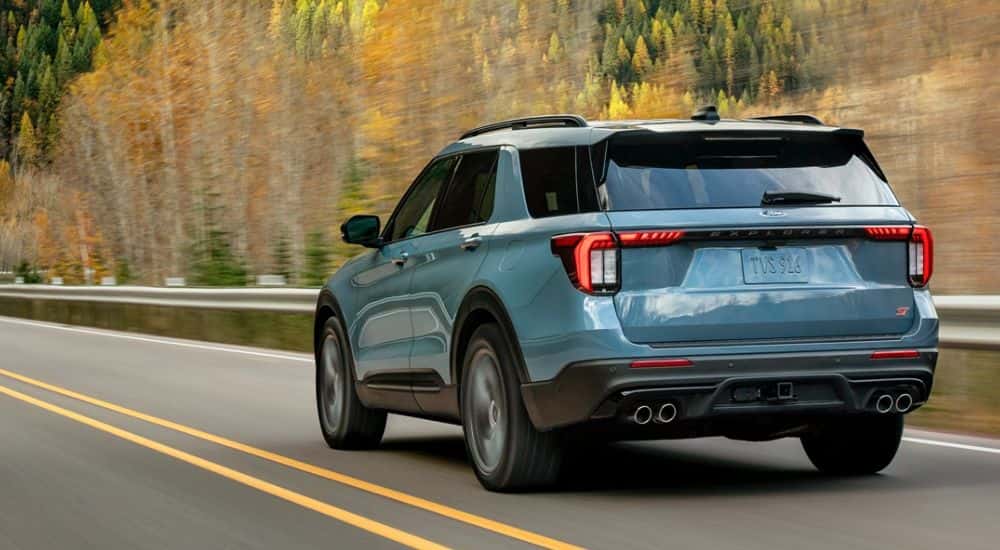
The Ford Explorer is tough to ignore if you’re looking for a new SUV that’ll do a lot more than simply get you from home to work and back again. Its smaller footprint makes it a pleasure to drive, while the Explorer’s rear-wheel drive design offers some notable benefits in terms of both performance and control.
The Explorer’s available V6 engine is sure to inject a little excitement into your daily commute, while the Tremor trim and 5,000-lbs towing capacity open the doors to weekends full of off-the-grid fun. Factor in the Ford’s comprehensive collection of safety tech and impressive ADAS features like BlueCruise, and it’s easy to see why the Explorer is America’s best-selling three-row SUV.
The Chevy Traverse isn’t a bad take on the three-row formula, but it fails to distinguish itself from the Explorer in any meaningful way. This might be a little easier to ignore if the Chevy came at a significant discount, but the Traverse often carries a higher MSRP. When you’re ready to get behind the wheel of the Explorer, Kings Ford is here to help. We carry a full range of new, used, and even Certified Pre-Owned models, which means there’s something for every driver and every budget.

0 comment(s) so far on Three Rows, No Compromises: How the 2026 Ford Explorer Beats the Chevy Traverse