
2023 Ford Explorer
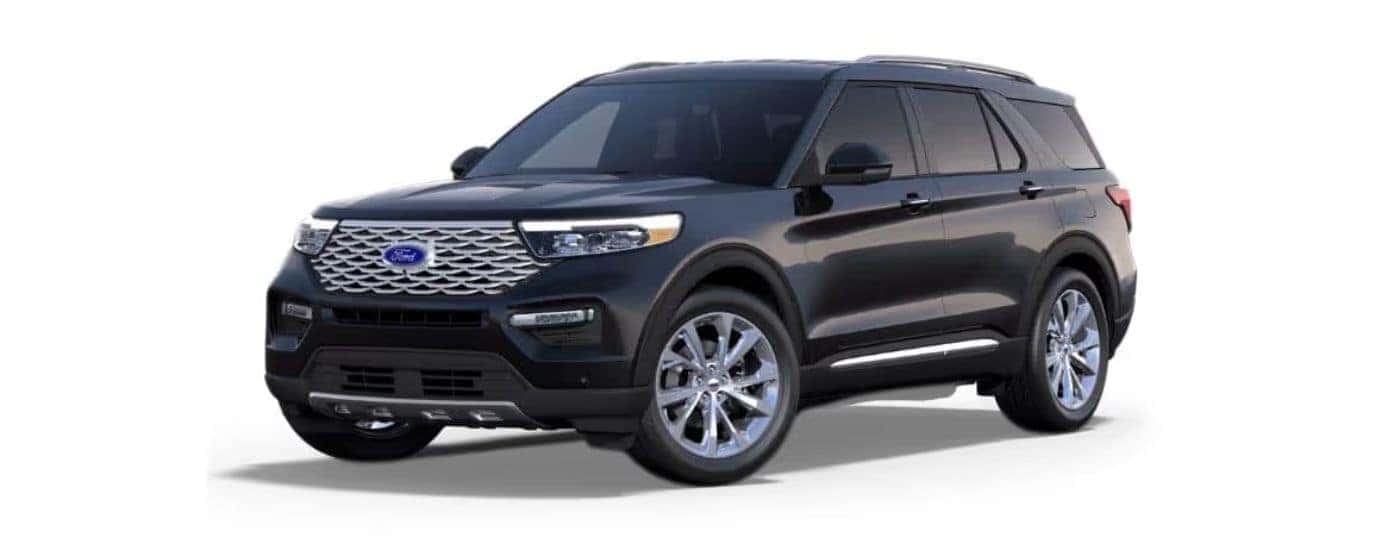
Since the early 1990s, Ford has developed the penultimate midsize SUV that reaps the benefits of reliability, versatility, efficiency, and a capable powertrain. Over thirty years later, this SUV has garnered critical acclaim for its stance in the market, providing a spacious and performant vehicle that rivals and stomps out many of its contemporaries. The 2023 Ford Explorer is the latest in this vehicle’s long lineage, and there are many reasons why people should be excited about the newest model. As a midsize SUV with three rows of seating, the Explorer fits better in most garages owing to its smaller size against full-size offerings like the Expedition while still providing space for a bigger family. The 2023 model has the features and kind of quality one would expect from a 2023 vehicle, including an emphasis on technology, safety, and performance.
The 2023 Ford Explorer’s base trim is the self-titled Explorer trim. You’ll find the base Explorer at an MSRP of $36,760, and the price incrementally increases should you opt for any of the seven following trims.[a] Eight trim levels are advantageous as you can configure your SUV to your liking. After the base trim, there’s the XLT, ST-Line, the off-roading-focused Timberline, Limited, ST, the classy and luxurious Platinum, and the capable King Ranch. Whether you prefer something simple and classy or want your SUV packed with all of the latest and greatest features available, there is an Explorer trim for you.
Performance
Three Levels of Power to Choose From
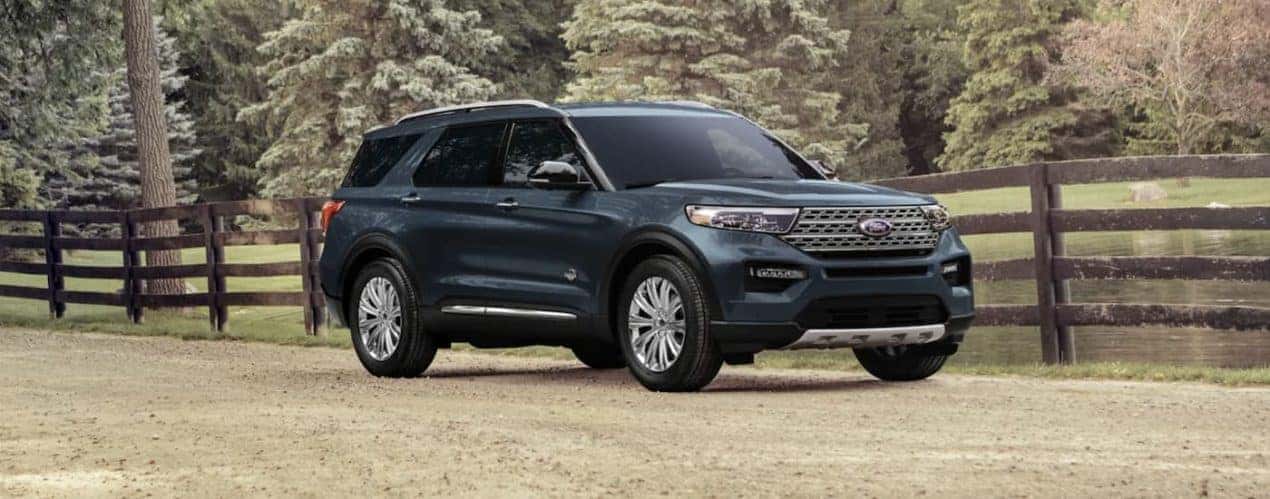
Three powertrain configurations are available for the Explorer: a turbocharged 2.3L I-4 engine, a turbocharged 3.0L V6 engine, or a 3.3L V6 hybrid. The trio of powertrains are all capable pieces of engineering, and fuel efficiency isn’t stricken too hard as the two turbocharged engines are naturally fuel-efficient by design. The hybrid powertrain is the most efficient, and it gets there by combining its engine with a motor and battery.
All three powertrains link have a ten-speed automatic transmission, which owners of the hybrid model may prefer over the CVTs that regularly tie to hybrid powertrains elsewhere. No matter which Explorer you purchase, your SUV will be able to handle up to 5,000 lbs, but the turbocharged engines have a slight advantage over the hybrid powertrain with the turbocharged 2.3L I-4 and turbocharged 3.0L V6 engines having maximum towing capacities of 5,300 and 5,600 lbs, respectively.
The 2.3L Turbo I-4
The base powertrain––the turbocharged 2.3L I-4 engine––outputs 300 hp and 310 lb-ft of torque. Because this performance stems from the base engine, drivers can comfortably expect excellent performance from the baseline upwards. The 2023 Explorer is available with either rear-wheel or all-wheel drivetrains. Pairing the base engine with rear-wheel drive means you’ll get EPA-estimated ratings of 21 MPG in the city and 28 MPG on the highway, and with all-wheel drive, you’ll have ratings of 20 MPG in the city and 27 MPG on the highway.
The 3.0L Turbo V6
It’s with the turbocharged 3.0L V6 engine that things get serious. Switching to trims where applicable, the 2023 Explorer with the V6 engine generates 400 hp and 415 lb-ft of torque. Driving the V6 engine provides a different and immediately noticeable experience, turning your Explorer into a powerhouse machine––a powerhouse that’s genuinely fun to operate. Rear-wheel drive models have slightly better fuel efficiency on the highway, with ratings of 18 MPG in the city and 26 MPG on the highway, and all-wheel drive models get EPA-estimated ratings of 18 MPG in the city and 24 MPG on the highway.
The 3.3L V6 Hybrid
The 3.3L V6 hybrid engine is a great option for those who really want to capitalize on fuel economy. This hybrid setup provides 318 hp and 322 lb-ft of torque. With the hybrid powertrain, the 2023 Explorer earns EPA-estimated ratings of 27 MPG in the city and 28 MPG on the highway with rear-wheel drive, and 23 MPG in the city and 26 MPG on the highway with all-wheel drive.
Size & Space

Not Too Big and Not Too Small
The 2023 Explorer seats a maximum of seven passengers with bench seats in the second row, but captain’s chairs are available as an alternative. Barring some models with slightly different dimensions––like the Timberline––the Explorer is 198.8 inches long and 69.9 inches tall. With these dimensions, you get up to 87.8 cu.ft. of cargo space inside the vehicle. Folding down the third row, which reduces the seating capacity to either four or five depending on which type of chairs you have filling your Explorer’s second row, leaves you with 47.9 cu.ft. If you’re traveling with the maximum amount of passengers, you’ll still have 18.2 cu.ft. of space, which is more than your average sedan.
Perfectly Sized to Seat Up to Seven
Choosing between the bench seats or captain’s chairs for your Explorer’s second row only reduces passenger capacity; it doesn’t change the amount of headroom, legroom, and other dimensions you and your passengers will have inside the vehicle. The Explorer being 69.9 inches tall means headroom isn’t a concern for both you our your passengers, which is evident by the 40.7 inches of headroom in the first row, 40.5 inches in the second row, and 38.9 inches in the third row.
Ford deserves recognition for the amount of legroom the Explorer has, especially in the third row. In the front row, you and your passenger will have 43 inches of legroom, your passengers in the second row have 39 inches, and your friends or family in the third row get 32.2 inches of legroom. These dimensions mean children will have no issues sitting anywhere in the vehicle, and the same goes for adults of various builds too. The hip room in the Explorer’s cabin is also generous, with 59.2 inches in the front, 59.1 inches in the second row, and 40.9 inches in the far back. Lastly, the shoulder room is also impressive, with 61.8 inches up front, 61.9 inches in the middle, and 54.6 inches in the back.
Off-Road Advantages
If you are an off-roader, the Timberline trim will be the one for you, thanks to some adjustments. The Timberline deviates from the other trim levels with a 23.5-degree approach angle as opposed to the 21-degree angle on the other trims and a 23.7-degree departure angle instead of 22 degrees. The Timberline also has a ramp break-over angle of 18.9 degrees instead of 17.1 degrees on the non-off-roading-oriented models and 8.66 inches of minimum ground clearance when the other Explorer trims have 7.9 inches.
Features

The Interior Is Packed With Comfort and Convenience Features
The 2023 Ford Explorer has a plethora of features. From the multimedia experience you’ll have with the integrated SYNC 3 infotainment center, the features designed to keep you and your vehicle harm-free, to the seat you sit in, the 2023 Ford Explorer has plenty of options. Your 2023 Explorer comes standard with a power liftgate, so if you’re carrying something heavy, you only need to touch the handle, and it’ll open.
The base model comes with cloth seats, and you get an eight-way power-adjustable driver’s seat. Higher-tier trims like the Platinum extend this eight-way power seat to your front-row passenger, and you get a ten-way power-adjustable seat, both of which are leather with heating and ventilation. The back seats are also wrapped in leather on the trims that have it as a material, and higher-tier models like the Platinum give second-row passengers heated seats too.
The Explorer’s infotainment system is powered by SYNC 3 technology. You will have Apple CarPlay and Android Auto compatibility, along with an available wireless charging station in the center console. Every model comes with a 4G LTE Wi-Fi hotspot. Get the Ford+Alexa app for easy voice-activated access to navigation, traffic information, and even Amazon Prime shopping.
The 2023 Explorer does away with the eight-inch touchscreen that came standard on older models and uses the 10.1-inch screen that used to be a premium feature instead. The bigger screen has many benefits, from easier-to-read text and more screen real-estate for your apps. Pricier Explorer models upgrade the audio system to a grandiose 14-speaker sound system implemented by Bang & Olufsen, with a built-in subwoofer to cap it off.

Come Start Your Next Journey in a 2023 Ford Explorer
Here at Kings Ford, we are ready to help you find the 2023 Ford Explorer trim that works best for you and your family. Our dealership accommodates drivers from all over, but if you’re in the greater area of Cincinnati, you can count on us to supply the vehicles you want to see and drive. We will help you figure out all of the financing too. Whether you prefer to get a lease or take out a loan, our team is ready to help you find the best rates possible for your current financial situation.
It’s a tough market out there, and you shouldn’t give your business to a dealership that doesn’t deserve it. You should find a dealership with a staff that equally cares about your purchase and supplies you with the tools and resources you need to keep your vehicle running smoothly for years to come. At Kings Ford, we do all of this and then some, so why not give our dealership a try? We’re located at 9555 Kings Auto Mall Rd, in Cincinnati, OH.
